
TheoryFrom your first sail to racing.
Want to beat even faster boats? You can — with your head. Here is a sailor's whole journey on one page: how to start, how to improve and what to do when. Explained simply, even for the youngest sailors in an Optimist.
The race is won before the gun goes off.
Two friends, two identical boats, the same wind. One has a plan, the other doesn't. You can tell them apart on the water at first glance:
Without preparation
- The wind shifts — and you just watch it happen.
- You get squeezed out at the start and don't even know how.
- After the race: "No idea why I finished last."
With preparation
- You expect the shift — you tack first and gain lengths.
- You have your spot on the line and clear wind.
- After the race you know exactly what to do better next time.
Not the second boat yet? Good news: preparation can be trained — and that is exactly what this page is about.
A sailor's journeyFour levels from your first sail to racing
Sailing is a game with levels — and just like in a game, you can't skip to the end. Age and pace are indicative; your coach sets the exact plan. You collect knots in Layline as you progress.
- Level 1age 6–10 · year 1
Fall in love with the water
1–2× a week (spring–autumn)
- Join a sailing club — the Optimist is the boat to start in.
- Learn to swim confidently and not to fear capsizing.
- Basics: where the wind blows from, steering, your first tack, three knots.
- Summer: a day camp or a club training camp.
Stage goal: joy on the water. Nobody cares about results.
- Level 2years 2–3
First races
2× a week + race weekends
- Sail 4–6 club and regional regattas per season.
- Learn the starting procedure and the basic right-of-way rules.
- Finish every race — even last place counts.
- A short note after every race: what worked, what to try next time.
Stage goal: finish your races and stop fearing starts.
- Level 3years 3–5
Systematic improvement
2–3× a week on the water + winter in the gym
- A year-round plan with your coach — water in season, fitness and theory in winter.
- A logbook entry for every sail in Layline and regular debriefs.
- One skill per training block: starts, tacks, gybes…
- Watch your numbers: tack count, speed, how your starts go.
Stage goal: stable technique and training habits of your own.
- Level 4age 12–15+
Competitive racer
4–6× a week including fitness work
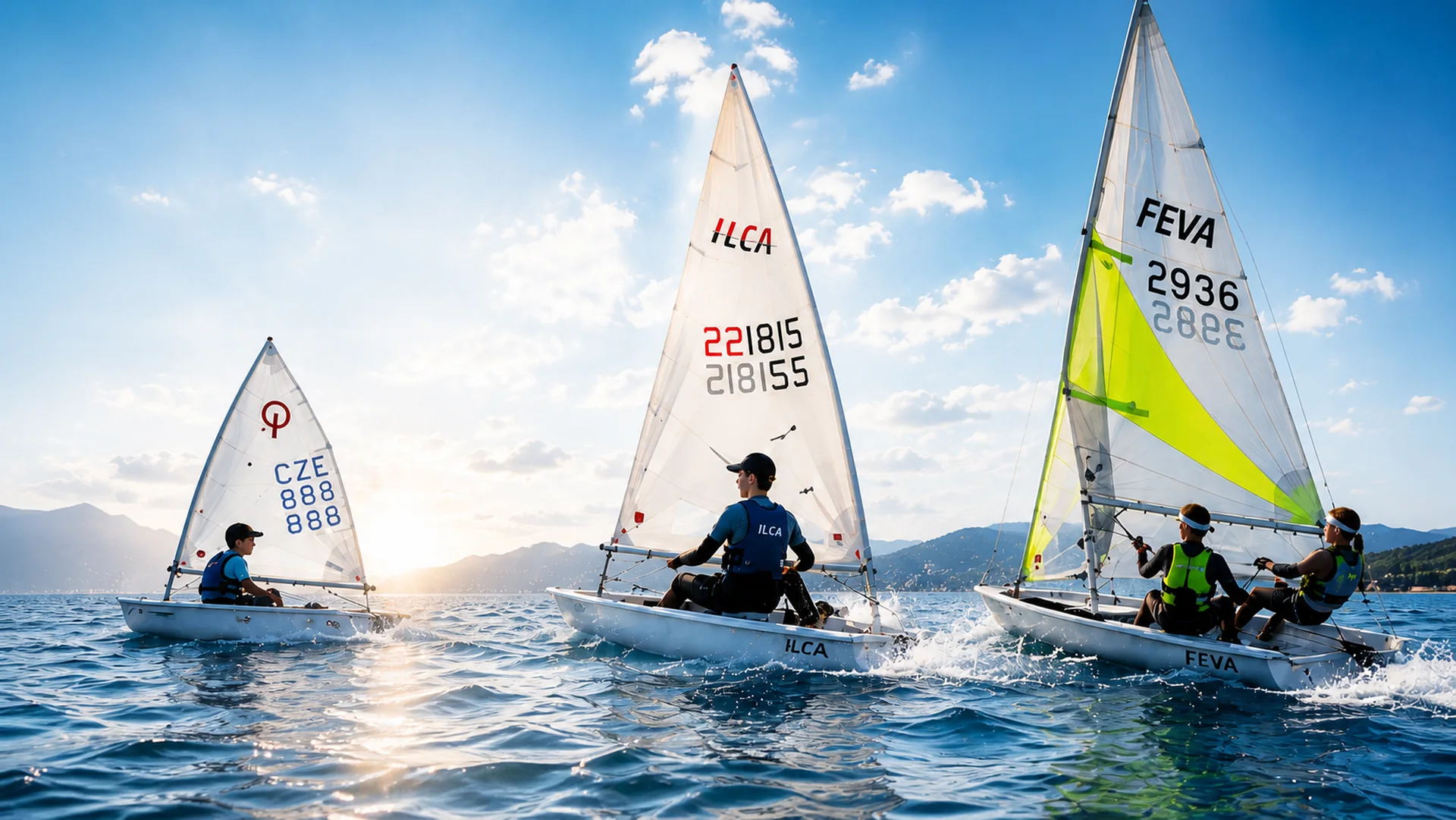
- Move up to a bigger boat: ILCA 4, RS Feva or 29er.
- National cups and your first regattas abroad (hello, Garda!).
- Mental routines: pre-race preparation, resetting after a mistake.
- Long-term goals for the season — and reviewing them with your coach.
Stage goal: race, don't just sail. And stick with it.
A sailor's yearThe season never ends — it just changes shape
Champions aren't made in July at a regatta, but in January in the gym and in April on cold water. Here is the whole year in one place:
Winter
December–February
- Theory and rules somewhere warm — videos, analysis, quizzes.
- Fitness 2–3× a week: core, legs, endurance. And swimming.
- Boat maintenance: varnish, ropes, tapes, bungs.
- In Layline: review the whole season and set your goals.
Spring
March–May
- Build up the hours — technique more than tactics.
- Blocks of tacks, gybes and starts (10 per session!).
- First "warm-up" regattas with no pressure on results.
- Wetsuit or drysuit — the water is still cold.
Summer
June–August
- Peak season: races and training camps.
- Easier weeks between regattas — recovery is training too.
- Try different waters: reservoirs, the sea, Garda.
- A logbook entry after every race while you still remember it all.
Autumn
September–November
- The tail of the season — stronger winds are the best school.
- The big season review with your coach: what grew, what's missing.
- A winter plan and goals for next season.
- Tidy the boat, wash it, put it away for winter. Say thank you to it.
Four steps to successTheory → Data → Strategy → Execution
The same process the big racers use, just said simply. Go through it before every race — the order matters: understand first, then measure, then plan and finally sail.
Theory
Learn how a race works
- The wind is the boss — everything on the course revolves around it.
- Know the course: start, upwind leg, marks, finish.
- The basic right-of-way rules, so duels don't scare you.
In Layline you'll find training notes and briefings from your coach.
Data
Gather information before the start
- Measure the wind: where it blows from and which way it shifts.
- Sail along the start line — which end is favoured?
- Look at the clouds, waves and current. What are they saying?
Layline saves the wind and conditions with every session.
Strategy
Pick a plan
- Decide: left or right side of the course?
- Pick your spot on the start line and the goal of the first beat.
- Have a plan B — what will you do if the wind shifts?
Go through the plan with your coach in a briefing right in the app.
Execution
Sail it — and write it down
- A clean start at full speed. Guard your clear wind.
- Hold your plan; don't change it because of one boat.
- After the race, note what worked. Next time you're smarter.
The track uploads itself; your coach adds the debrief.
Pre-race checkThree minutes on shore can save the whole race
Run through it like pilots before takeoff — out loud and in order. Most races are lost before the boat even touches the water.
Boat
- Bungs! Check them twice.
- Knots and sheets hold, nothing is frayed.
- Rudder and daggerboard move smoothly.
- Sail properly tensioned, clips secured.
Me
- Life vest zipped up, clothes to match the weather.
- Water and a snack in the boat.
- Sunscreen (the water burns you twice).
- I know how many races are on today and when I start.
Head
- I know the signals and flags of the starting procedure.
- I have a plan from my coach — and I understand it.
- I know what I'll do if something goes wrong.
- I am calm. Racing is a game.
Planning the raceFrom launch to finish, step by step
−60 min
Launch early
Warm up, try some tacks and gybes. Boat and body both need to wake up.
−30 min
Measure the wind
Every few minutes, check where it blows from. Is it shifting left or right?
−15 min
Sail the start line
Find out which end of the line is closer to the wind — that's where starting pays off.
−10 min
Confirm your plan
Which side of the course has more wind? Left, right or the middle? Decide now.
−5 min
Find your spot
Stay close to the line, watch the clock and keep clear space to leeward.
START
Full speed at the gun
Cross exactly on time, at speed and with clear wind. The start is half the race.
1st beat
Hold the plan
Sail to your side. Tack when the wind shifts against you.
Mark
Get ready early
Sort your sheets before the mark and think the rounding through. No rush, no chaos.
Finish
Write it down and ask
Right after the race, note in Layline what worked and what didn't. And talk it through with your coach.
A classic course under rule 28 of the Racing Rules of Sailing (RRS): marks are rounded in the prescribed order. After the start you beat straight to mark 1 — the gate doesn't matter on the upwind leg. You only pass through the gate on the downwind run: sail between its marks and round one of them.
Coaches' adviceNumbers you'll remember on the water
Lessons the world's best coaches keep repeating — from Olympic campaigns to club Optimists. They aren't laws: they're starting numbers to fine-tune with your coach for your boat and your waters.
Trim your sail to the wind
The golden shortcut: the more it blows, the flatter the sail. Your coach will give you the exact marks on the lines — this is the shape you are looking for.
Light windunder 6 knots
- Sail
- A full, deep sail — ease the control lines so it keeps a "belly".
- Body
- Sit forward and keep still. Every needless move slows you down.
- Goal
- Keep the boat moving. Speed is precious — don't waste it on tacks.
Medium wind6–12 knots
- Sail
- Baseline settings from your coach. The sail pulls at full power.
- Body
- Balance with your body, keep the boat flat. This is where boats sail fastest.
- Goal
- Clear wind and good lanes. Now races are won with tactics.
Strong windover 12 knots
- Sail
- A flat sail — pull everything on so the excess pressure escapes.
- Body
- Weight out and forward against nosediving. A firm grip on the sheet.
- Goal
- Survive the gusts without capsizing. Whoever sails flat, wins.
How much of what — and why
1–2 lengths
What every tack costs
A tack isn't free — you lose speed and distance. Tack only for a reason: a wind shift, clear air, the layline.
4–8 tacks
Usually enough for one beat
Tack twice as often and you're giving away lengths for free. Count your tacks and check in Layline after the race how many there really were.
0° of heel
A flat boat is a fast boat
In medium and strong wind keep the deck level. Only in light wind let the boat heel slightly to leeward so the sail keeps its shape.
10 starts
Every training day
The start is the tightest moment of a race — and only repetition trains it. Ten short starts teach more than an hour of talking.
1 theme
Per session
Today tacks. Tomorrow starts. Train five things at once and none of them improves. Write the theme in your logbook beforehand.
80 : 20
Sailing vs. talking
Most of the time belongs to the water. A short briefing, a long session, a short debrief — and notes in Layline while you still remember it all.
"You haven't won the race if in winning the race you have lost the respect of your competitors."
Golden rulesFive sentences that win races
The wind is the boss
Watch it constantly. Whoever spots the shift first, wins.
A clean start is half the race
Better a metre back and at speed than first and parked.
One side, one plan
Don't change your plan mid-beat because of one boat.
Clear wind > duels
A duel with a friend costs two places. Sail your own race.
Write it down after the race
What you don't write down, you forget. A logbook turns mistakes into lessons.
Theory only works if you train it. Log your sails in Layline and go through them with your coach — and collect knots for every bit of progress.
Check out the rewards